
The value of living soil, measured.
Regenerative farming is known for 16 benefits, from healthy soils to spiritual connection. Some already have a price, many are measured but unpriced, and a few have no mechanism at all. We put a number next to every one of them, starting here.
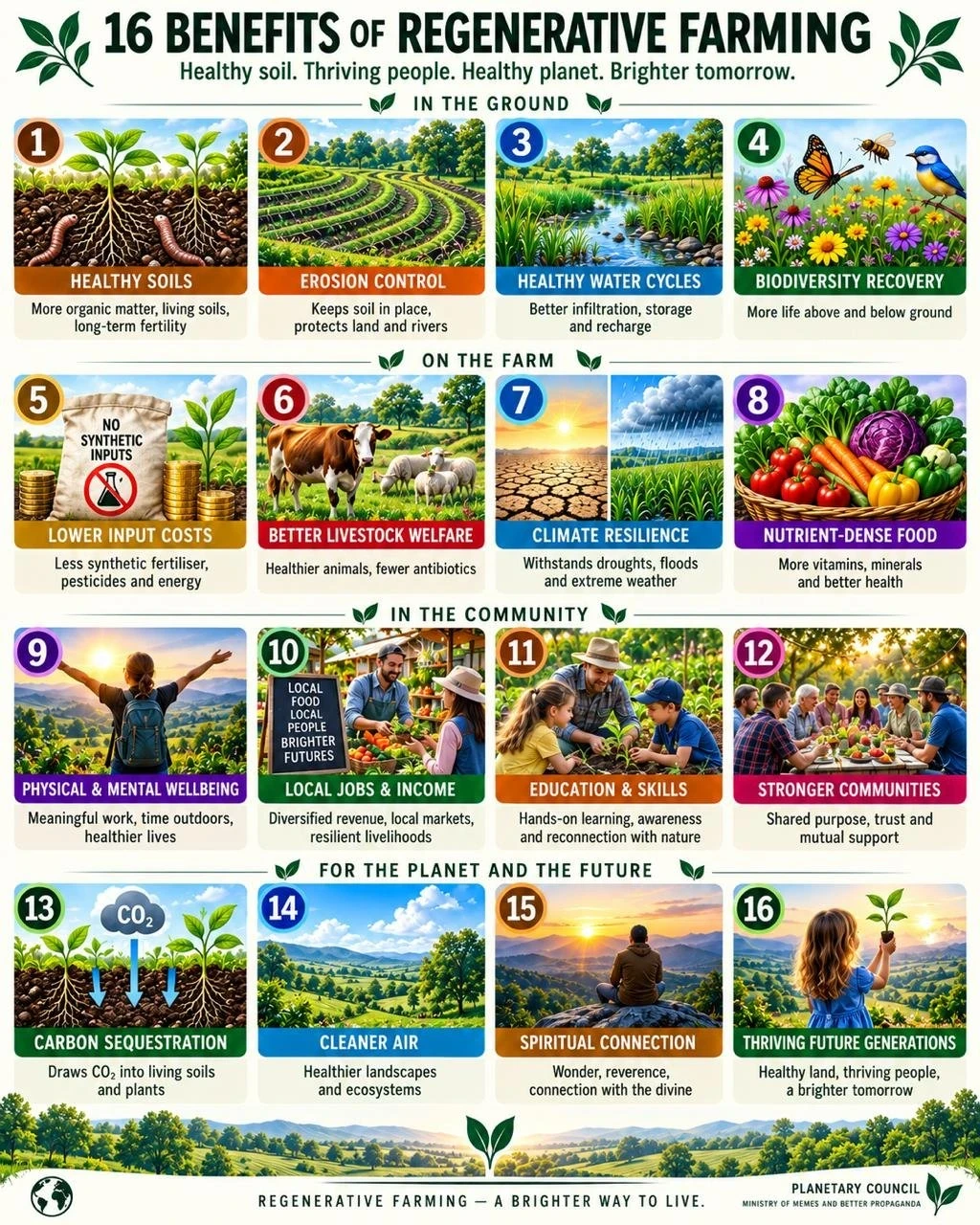
The 16 benefits, as the regenerative movement tells it. Tap to enlarge.
Leaders in technology are not always leaders on nature. So we measure what is hardest to measure, on purpose.
Many of the people shaping the future live in New York, San Francisco and London. City life keeps most of us far from the soil that feeds us, and what we don't see, we don't value.
That's why BaseX makes it a mission: whenever impact is hard to quantify, we quantify it deliberately. The gap is rarely a lack of value. It's a lack of a mechanism to measure and price it. Regenerative farming is where we start.
16 benefits, 16 measures.
Every benefit on the infographic can be measured. Here is how, the price or value it carries today, and where it fits the six domains of the Ecological Benefits Framework (EBF)22.
already have a price somewhere in the economy, usually the cost of the damage
are measured, but nobody pays for them yet
have no mechanism to measure or price them yet
| # | Benefit | How to measure it | Price or value today | EBF | Status |
|---|---|---|---|---|---|
| In the ground | |||||
| 01 | Healthy soils | Soil organic matter %, soil biology tests | Soil degradation costs £1.2B a year in England and Wales1 | Soil | Priced |
| 02 | Erosion control | Tonnes of soil lost per hectare | Part of that £1.2B1. US Corn Belt topsoil loss: about $2.8B a year2 | Soil | Priced |
| 03 | Healthy water cycles | Infiltration rate; nitrate in drainage water | Priced through the damage: Lough Neagh water cost about £28M to treat in 2022–233 | Water | Priced |
| 04 | Biodiversity recovery | Biodiversity units, Defra statutory metric | Statutory biodiversity credits start at £42,000 each4 | Biodiversity | Priced |
| On the farm | |||||
| 05 | Lower input costs | Spend per hectare on fertiliser, sprays and fuel | Fertiliser: £407/ha on feed wheat5. Modelled regenerative margin 31% above conventional by year six18 | Beyond EBF | Priced |
| 06 | Better livestock welfare | Antibiotic use, mg per kg of animal | UK food-producing animals: 15.6 mg/kg in 20246. No price | Beyond EBF | Measured |
| 07 | Climate resilience | Yield lost in drought and flood years | Up to 50% smaller losses in bad years, modelled for Germany7 | Beyond EBF | Measured |
| 08 | Nutrient-dense food | Vitamins, minerals and phytochemicals per crop | Early evidence only, from 8 farm pairs8 | Beyond EBF | No mechanism yet |
| In the community | |||||
| 09 | Physical & mental wellbeing | ONS life satisfaction score, 0–10 | HM Treasury values 1 point, for 1 person, for 1 year at £13,000 (a WELLBY)9. Not yet applied to farms | Beyond EBF | Measured |
| 10 | Local jobs & income | Jobs and local spend per 100 hectares | No standard price found | Equity | Measured |
| 11 | Education & skills | Participants and hours of learning | No standard price found | Equity | Measured |
| 12 | Stronger communities | Trust and belonging surveys | No agreed measure or price | Equity | No mechanism yet |
| For the planet and the future | |||||
| 13 | Carbon sequestration | Soil carbon in tonnes CO₂e per hectare, sampled to depth | UK woodland carbon valued at £131.5B10. Soil carbon gains are still contested11 | Carbon | Priced |
| 14 | Cleaner air | Ammonia emitted, kg per hectare | Ammonia damage: £9,667 per tonne12. Farms emit 88.7% of UK ammonia13 | Air | Priced |
| 15 | Spiritual connection | Nature Connection Index15; ONS "life worthwhile" score | Highly connected people are 1.7× likelier to say life is worthwhile14. No price yet | Beyond EBF | No mechanism yet |
| 16 | Thriving future generations | Natural capital accounts: the value of land as an asset | ONS values UK woodland at £351.4B10. Farmland is not yet valued this way | Beyond EBF | Priced |
Prices come from different schemes, years and methods, so they can't be added together. Where a price exists, it is usually the cost of the damage, not the value of the benefit. The EBF mapping is ours.
The old system sends two invoices.
The farmer pays the first: fertiliser, sprays and fuel. Everyone else pays the second, through water bills, lost soil and dirty air. It never appears on the farm's books.
Cost of soil degradation in England and Wales. 80% of it falls off the farm.1
Of England's surface waters reach good ecological status. Farm nutrients are one of the named pressures.16
Of the phosphorus feeding Lough Neagh's algae comes from farming. The lough supplies 40%+ of Northern Ireland's drinking water.17,3
Modelled regenerative arable margin over conventional by year six, after a weaker start.18
The switch costs money up front: in the same model, food margin starts 64% below conventional before support payments18. A credible price on the benefits is what funds the bridge.
Wonder, reverence, connection with the divine.
These are real reasons people farm and protect land. The value is real. What's missing is a mechanism to measure and price it, and that is exactly the problem BaseX exists to solve.
Part of the mechanism already exists. The UK Treasury puts £13,000 on one point of life satisfaction, for one person, for one year9. The rest we build in the open, with the people who do the work.
Of the farming community in England and Wales are probably or possibly depressed.19
Wellbeing among regenerative farmers in Australian surveys: a small but significant gap. Early evidence.20,21
More likely to say life is worthwhile, for people highly connected to nature in England.14
Per WELLBY: the Treasury's value for one point of life satisfaction for one year.9
EBF names six benefits. We go further.
The Ecological Benefits Framework, a program of The Lexicon, describes impact across six domains: Air, Water, Soil, Biodiversity, Equity and Carbon22. BaseX already uses these as claim tags, so regenerative claims stay comparable.
Seven of the 16 benefits fall outside those six, including welfare, nutrition, wellbeing and spiritual connection. We price those too.
Let's price the whole farm.
Bring a regenerative project and its data in any format. We'll turn each benefit into a claim, have it priced by independent evaluators, and keep every number open to challenge.
Or email [email protected]
Every number, with its source.
- Graves et al. (2015), The total costs of soil degradation in England and Wales Ecological Economics · peer-reviewed
- UMass Amherst (2021), summary of Thaler et al., PNAS University summary
- Al Jazeera (2023), Worst-ever contamination of Ireland's largest lake News
- GOV.UK, Statutory biodiversity credit prices Official
- AHDB (2026), Indicative gross margins for harvest 2027 Industry body · estimate
- Veterinary Medicines Directorate, UK-VARSS 2024 highlights Official
- BCG & NABU (2023), The case for regenerative agriculture in Germany and beyond Consultancy · modelled
- Montgomery et al. (2022), Soil health and nutrient density PeerJ · peer-reviewed, preliminary
- HM Treasury (2021), Wellbeing guidance for appraisal Official · 2019 prices, range £10,000–16,000
- ONS (2022), Woodland natural capital accounts, UK Official
- Prairie, King & Cotrufo (2023), PNAS, via summary Peer-reviewed
- Defra (2023), Air quality damage cost update Official · 2022 prices
- NAEI (2026), UK Agriculture Ammonia Emission Report 1990–2024 Official
- Natural England, nature connectedness and wellbeing (MENE) Official
- Richardson et al. (2019), A measure of nature connectedness Sustainability · peer-reviewed
- Envirotec (2026), reporting Environment Agency classifications Trade press
- FactCheckNI, Lough Neagh phosphorus Fact-checker · NEW Harmonica model
- Savills (2024), Can farmers afford to switch to regenerative farming? Consultancy · modelled farm
- RABI (2021), The Big Farming Survey Charity survey · 15,000+ respondents
- University of Canberra, Regenerative agriculture and farmer wellbeing Doctoral thesis
- Agriculture and Human Values (2025), rapid review Peer-reviewed · finds evidence still scarce
- EBF Commons, Ecological Benefits Framework The Lexicon